
ROOF
The roof is more than the tiles you can see
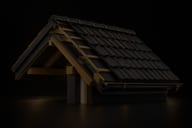
What keeps the house dry lies under the tiles: the roof underlay of tongue-and-groove boarding with felt or membrane, the battens and the metal flashings around the chimney, valleys and roof windows. Tiles and sheet metal are the outer shell. When a roof starts to leak, the fault is often at a penetration or in the eaves, and the water may have travelled a long way before the stain shows on the ceiling.
Relut does the carpentry around the roof: bargeboards, capping boards, eaves, minor repairs to roof boarding and battens, and the timber work around roof windows. The roofing itself, meaning a new underlay and new roof covering, is carried out by a roofer we work with, and we coordinate the work. The written quote states who does what and who is responsible for each part. The home visit is free of charge throughout Stockholm County.
What we can help with
Our own carpentry around the roof, and coordination of what needs a roofer or sheet-metal worker.
Bargeboards and capping boards
The bargeboards and capping boards on the gables take driving rain and sun head-on. We replace rotten timber, prime the end grain and paint, so the outer edge of the tiles and the ends of the battens are protected.
Eaves and fascia boards
We replace rotten fascia boards and soffit boarding and make sure the air gap at the eaves is open and fitted with insect mesh, so the loft keeps being ventilated as intended.
Roof boarding and battens
Smaller areas of damaged roof boarding, counter battens and tiling battens are replaced as part of the roof work. Larger damage to the underlay or the roof trusses is assessed together with a roofer and, if necessary, a structural engineer.
Carpentry around roof windows
We do the timber work at roof windows: studs between the trusses, insulation, internal reveals and trims. The flashing against the roof covering is done by the roofer. If a truss has to be cut, a structural engineer is brought in.
Re-roofing through a roofer
A new underlay, new battens and new tiles or sheet metal are laid by a roofer we work with. We coordinate timing, scaffolding and carpentry so the house stands open for as short a time as possible.
Gutters and downpipes
Gutters that leak at the joints or slope the wrong way soak the eaves and the facade. We check the fall and the fixings when we work on the eaves. Replacement and sheet-metal work are carried out by a roofer or sheet-metal worker.
GOOD TO KNOW
Good to know about roofs
Building technique and rules that affect what needs doing and who is allowed to do it.
Signs that the roof is leaking
Damp stains on the ceiling, dark streaks or frost on the underside of the roof boarding, cracked tiles and rotten eaves are warning signs. According to Boverket (the National Board of Housing, Building and Planning), water can leak in through very small gaps at penetrations, joints, valleys and fixings, and a leak that is not found in time can cause extensive damage further down in the house. Go up into the loft with a torch after heavy rain.
A cold loft must be able to breathe
In a cold (unheated) loft, moisture must be able to air out. TräGuiden’s construction examples specify a ventilating air gap at the eaves of at least 25 millimetres with insect mesh, and a wind deflector that guides the air past the insulation. When extra insulation is added to the loft floor, the loft becomes colder and usually damper, Boverket writes. So seal against the living space first, so that warm indoor air does not leak up, and make sure the insulation does not block the gap.
Roof ladder, ladder stop and snow guards
Boverket’s regulations BFS 2024:9 require a means of access, fixed equipment for moving across the roof and protection against falls when the roof has to be walked on for the running of the house, for example to sweep a chimney. A loose ladder may be used where the climbing height is small if the house has a ladder stop that prevents the ladder from sliding. Protection against falling snow and ice must be in place at entrances where there is a particular risk. The requirements apply to new buildings and may be adapted when a building is altered.
Building permit and fall protection for roof work
Since 1 December 2025, changing the roof covering material or colour on one- and two-dwelling houses does not as a general rule require a building permit (bygglov). Exceptions apply to buildings and areas of particular heritage value and to extended permit requirements in the detailed development plan, so ask the building committee (byggnadsnämnden) if in doubt. During the work, the rules of Arbetsmiljöverket (the Swedish Work Environment Authority) apply: at a fall height of two metres or more, fall protection is required, first scaffolding or guard rails and second personal fall protection equipment.
How it works
How a roof job works
Three steps from first contact to a quote where responsibility is clearly divided.

Describe the roof
Get in touch and tell us what you have seen: leaks, loose tiles, rotten bargeboards or plans for a roof window. If you can, give the year the house was built, the roof material and the approximate pitch, and send photos from the ground and from the loft.

Free home visit
We look in the loft for damp stains and ventilation, feel the eaves, bargeboards and visible roof boarding, and assess the gutters, the need for scaffolding and whether a roofer needs to be involved. The visit is free of charge throughout Stockholm County.
Written quote
The quote describes the carpentry work, timber and surface treatment, what the roofer carries out, scaffolding and fall protection, and the price with the ROT deduction (ROT-avdrag) shown. It also states who is responsible for each part of the work.


What affects the price?
The price depends on the size, pitch and height of the roof, how much timber is damaged, how easy it is to reach and whether scaffolding is needed. Hidden damage in the roof boarding often only shows when the tiles are lifted, and the quote states how that is handled. The ROT deduction (ROT-avdrag) is 30 per cent of the labour cost, up to SEK 50,000 per person per year, and does not cover materials or travel. The price is given in a written quote.
Book a free home visitWould you rather talk to us directly? Call or email us
Free roof home visit in Stockholm County
Tell us what you want done and we will get back to you. Call, email or fill in the form. The home visit and the quote cost nothing, wherever you live in Stockholm County.
Frequently asked questions
Straight answers about Roof before you decide.
No, the roofing itself is carried out by a roofer we work with. We do the carpentry around the roof, meaning bargeboards, eaves, minor repairs to roof boarding and battens and the timber work at roof windows, and we coordinate the work. The quote shows who carries out each part and who is responsible for it. So you know in advance who will be coming to the house and what each of them does.
That is decided by the condition of the underlay, not by how the tiles look. A few cracked tiles, a leaking valley or a rotten bargeboard can often be dealt with on their own. If the underlay felt is brittle, the battens are rotten in several places or the roof boarding is discoloured over large areas, that points to re-roofing. We look in the loft and at the eaves and bring a roofer along for an assessment when needed.
It cannot be answered with a number of years, because the lifespan depends on material, pitch, location and maintenance. Clay and concrete tiles generally last longer than the felt and battens they lie on, so it is often the underlay that decides when the roof needs re-laying. Cleared gutters, intact flashings and a dry, ventilated loft extend the lifespan. The condition has to be assessed on site.
As a general rule no, for one- and two-dwelling houses. Since 1 December 2025, no building permit (bygglov) is required to change the colour or material of the roof or facade on such houses, according to Boverket. A permit may still be required if the building or the area is of particular heritage value or if the detailed development plan has extended permit requirements. A heavier roof material can also affect load-bearing parts, which may require a notification (anmälan). Ask the municipal building committee (byggnadsnämnden).
Yes, in a house that you own, repair and replacement of roof tiles and gutters qualify for the ROT deduction (ROT-avdrag) according to Skatteverket (the Swedish Tax Agency), as does scaffolding put up for the work. The deduction is 30 per cent of the labour cost, up to SEK 50,000 per person per year. Materials are not included. In a housing cooperative (bostadsrätt) there is no deduction for work on the outer roof, because it lies outside the home.
Yes, we do the carpentry around the roof window and a roofer does the flashing against the outer roof. If the window fits between two trusses without any being cut, the load-bearing parts are not normally substantially affected, and according to Boverket no notification (anmälan) is then required. If a truss has to be cut, a structural engineer and a notification to the municipal building committee are needed, with a start clearance (startbesked) before work begins. In areas of particular heritage value a building permit may be required.
Look for damp stains, dark streaks and growth on the underside of the roof boarding, especially around the chimney, ventilation hoods and along the eaves. Check that the insulation is not packed tight against the roof at the eaves, blocking the air gap. Feel whether the timber is soft. Do the check after heavy rain and at some point during the winter, and take photos. They are useful to us before the home visit.
No, the home visit and the quote are free of charge throughout Stockholm County. We assess what can be seen safely from the loft, from the ground and from the eaves. If the roof has to be walked on for a closer assessment, that is planned together with the roofer and with fall protection. After the visit you receive a written quote that separates our carpentry from the roofer’s work.